
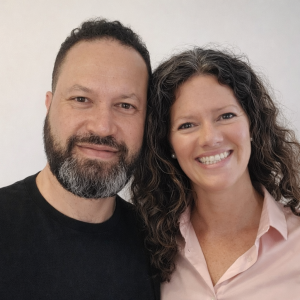
facilitated by: Kyla MacDonald and Wayne Kingi.
Fresh from Alex Sloley’s thought-provoking session, we move into a fast-paced, collaborative unconference—designed to channel all that curious, slightly uncomfortable energy into something constructive. Think of it as a living laboratory: part exploration, part experiment, and part community strategy session.
Intentionally light in structure and rich in possibility, we adopt the spirit of Open Space, following four principles and one rule.
- Four principles:
- Whoever shows up are the right people — because those in the room are exactly who the conversation needs.
- Whatever happens is the only thing that could have — staying open to emergence, not perfection.
- Whenever it starts is the right time — ideas don’t always run to schedule.
- When it’s over, it’s over — we stop when the energy ebbs, not when the clock insists.
- One rule:
- The law of two feet — if you’re not learning or contributing, move to somewhere you can—or take a break.
It lets the room shape the conversation, surface contradictions, reconnect with purpose, and imagine possibilities — not only for agile practice but for the identity of our community and the conference itself.
It’s not about consensus.
It’s about connection, curiosity, and courage.
This is where you—the participants—take now the wheel.
1. Opening circle (10 minutes)
We gather as one group to set context and expectations:
- A quick reminder of “the law of two feet” — if you’re neither contributing nor learning, move.
- A shared intention: to explore the state of agile practice today, future possibilities, and the evolving identity of AOTBNZ.
- A simple framing question is offered to spark ideas:“If agile were reinvented today, what would we keep, change, or abandon?”
- Brief open discussion for any questions.
The aim is to make the space feel safe, playful, and open.
2. Topic pitching & agenda building (15 minutes)
Participants step forward and pitch topics they feel drawn to — insights from Alex’s session, frustrations felt, emerging opportunities, bold dreams, or heretical thoughts about agility, ways of working, or the conference itself.
Examples might include:
- “What if agile genuinely embraced complexity?”
- “Should it still be ‘*Agile* on the Beach NZ’?”
- “Team practices that quietly died and nobody noticed.”
- “How do we design ways of working for a regenerative future?”
We quickly cluster similar topics, vote with stickers or dots, and build a visible agenda with four breakout spaces and two time slots.
The agenda is created by the room, for the room.
3. Breakout round 1 (35 minutes)
Participants choose whichever topic resonates most.
Each group self-organises:
- Nominate a facilitator/timekeeper (usually the person who pitched the topic)
- Nominate a scribe
- Agree the core question
- Capture insights on butcher’s paper, whiteboard, or sticky notes
The energy tends to oscillate between lively debate and reflective pauses — a good sign we’re onto something meaningful.
4. Break (10 minutes)
Coffee, fresh air, stretching, beach wander — whatever helps reset the mind.
This breathing space also allows cross-pollination (“You should have heard what came up in the complexity group…”).
5. Breakout round 2 (35 minutes)
Participants pick a second topic — continuing earlier conversations or jumping into something fresh.
This round often produces deeper, more imaginative work because the ice is well and truly melted, and people have connected around shared curiosities.
Encourage groups to focus not only on discussion but signals, insights, and provocative questions worth feeding back to the wider community.
6. Closing harvest (15 minutes)
We regroup as one group to surface the collective wisdom.
Each breakout gives a 2-minute summary, covering:
- The question explored
- One insight that surprised the group
- One tension or challenge worth wrestling with
- One seed or spark to influence the future of the Agile on the Beach community
We close with a final reflection prompt:
“What’s one idea from today that you’d love to see lived, not just talked about?”
Harvest notes are gathered and will directly inform the future of the conference — and the future of agile in Aotearoa.